

Creating climate-ready classrooms with clean energy across the Marshall Islands
Funding round: one
Country: Republic of the Marshall Islands
Sector: Education
REnew Pacific’s first project in the Republic of the Marshall Islands (RMI) will deliver clean, reliable solar power to 19 remote primary schools across Arno, Ebon and Mili Atolls. Delivered by UNICEF Australia, alongside UNICEF Pacific, the Ministry of Education, Sports and Training including the Public School System, and the Environmental Protection Authority, the project will solarise every primary school across these atolls, schools that currently do not have access to electricity.
Cyclone-resilient solar systems with battery storage will power classrooms, lighting, digital learning tools, and water and sanitation facilities. This will improve learning conditions, support inclusive and technology-enabled education and strengthen schools’ ability to function as safe community spaces during emergencies. The project will directly benefit more than 700 children and 90 teachers, with a further 1,300 community members supported when schools are used as emergency shelters.
The project complements the Government’s Rebbelib; Connecting Our Islands for Learning program, ensuring that investments in connectivity, digital learning and assistive technologies can be used consistently in some of the Marshall Islands’ most remote communities.
$2,000,000
$2,000,000
DFAT contribution
$898,704
$898,704
Partner contribution
$2,898,704
$2,898,704
Total funding
Partner
UNICEF works in more than 190 countries and territories to protect and improve children’s lives. UNICEF Australia mobilises Australians, through fundraising, partnerships and advocacy, to support that work and lead child‑focused initiatives here and in our region.
UNICEF Pacific works with and for disadvantaged children and adolescents across the Pacific Islands.
The Ministry of Education, Sports, and Training (MOEST) in RMI is the government body responsible for overseeing and managing the nation’s education, sports, and vocational training sectors, including public schools (PSS) and technical training (NTC), working to improve access, quality, and cultural relevance in learning.
The Republic of the Marshall Islands Environmental Protection Authority (RMIEPA) is the primary government body tasked with protecting the environment, managing natural resources, ensuring public sanitation, and overseeing environmental education in the Marshall Islands, handling issues from water quality and waste to climate change adaptation.
About this project
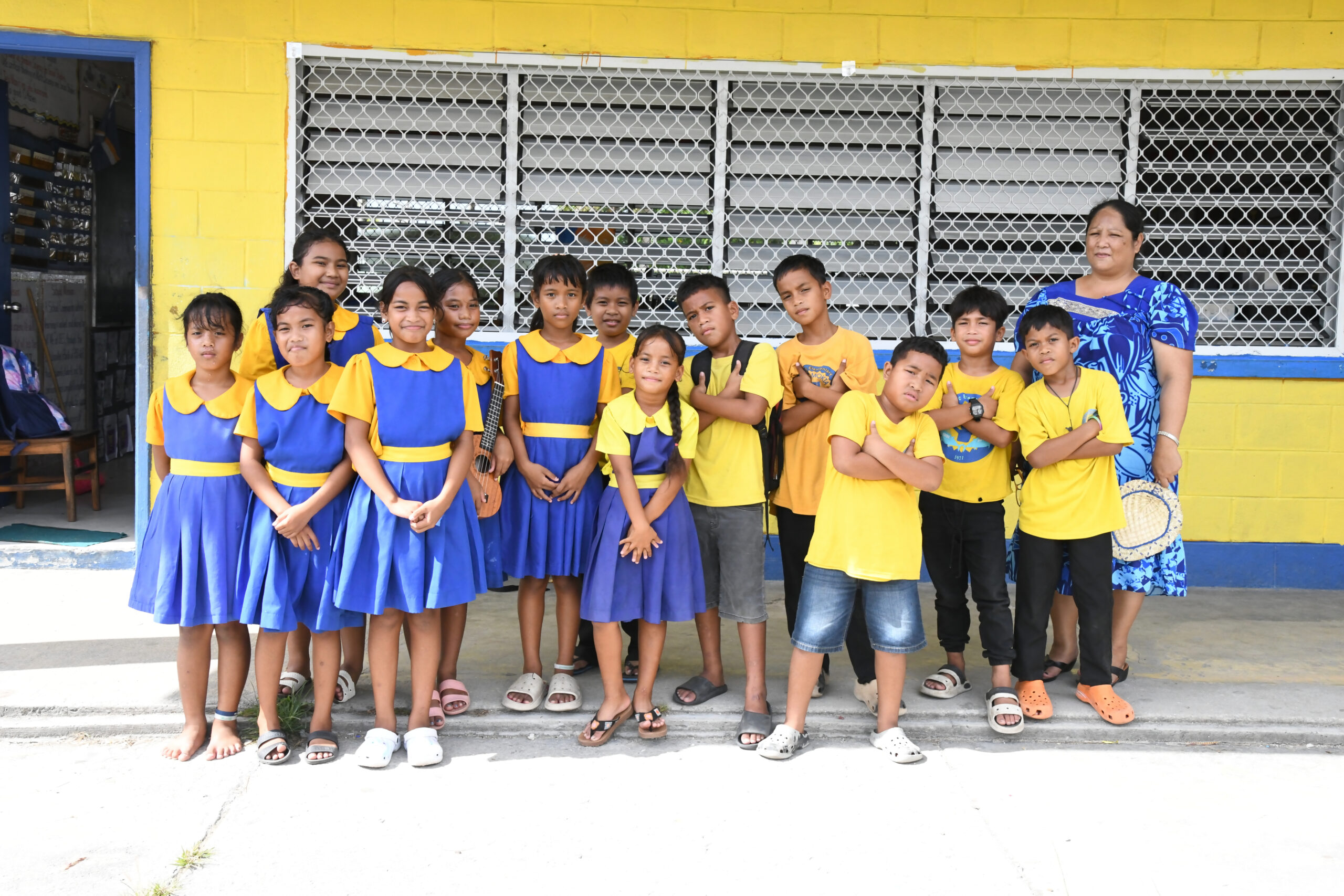
The project will install photovoltaic solar systems with secure battery storage at 19 remote schools across Arno, Ebon and Mili Atolls. Designed for outer island conditions, where grid extension is not viable and diesel generation is unreliable and costly, each system will include elevated, corrosion-resistant ground-mounted solar arrays, safely fenced for durability and battery enclosures designed to minimise fire risk, overheating and saltwater intrusion. Solar-powered lighting, water pumps, maintenance toolkits and spare parts will also be provided.
Gender equality, disability inclusion and safeguarding are embedded throughout delivery. Community consultations will actively engage women, girls and people with disabilities to inform system design, lighting placement, sanitation access and safety features, including menstrual hygiene management. Reliable power will enable the effective use of assistive technologies for children with disabilities and improve safety and accessibility for all students.
Long-term sustainability is supported through a strong operations and maintenance (O&M) model. System sizing will align with government standards and be finalised through feasibility assessments with school communities. Inclusive training will build local capacity among school staff, Parent-Teacher Associations, women, youth, people with disabilities and local technicians. School-level O&M plans will be integrated into Public School System budgets, supported by Marshallese-language manuals, maintenance toolkits and remote diagnostics to monitor system performance and address faults over time.
Context
RMI is a low-lying ocean nation of scattered atolls, many sitting just two metres above sea level. This geography leaves communities highly exposed to sea level rise, extreme weather and freshwater shortages. According to the Notre Dame Global Adaptation Initiative, it is among the world’s most climate-vulnerable countries, with acute risks facing remote outer island communities.
Education infrastructure reflects these challenges. Analysis by the Ministry of Education, Sports and Training shows that nearly one in five public schools is in poor condition. Across the outer islands, schools rely almost entirely on rainwater for sanitation and lack access to electricity, limiting lighting, safe WASH services, digital learning and connectivity. These constraints undermine attendance, learning outcomes and teacher retention and are compounded by teacher shortages and long, often unsafe travel distances to Majuro, the nation’s capital.
Focusing on 19 schools that represent 26 per cent of all schools nationally, this project responds directly to these challenges. Solar energy offers the most viable and sustainable solution for isolated atolls, aligning with national energy and education priorities. By linking climate-resilient infrastructure with inclusive education delivery, UNICEF and the Public School System are strengthening learning environments and community resilience, ensuring schools can better serve children, teachers and communities, including during emergencies.
We are deeply grateful to the Australian Government, through DFAT, and to UNICEF, for their continued partnership and investment in the future of children. This collaboration demonstrates a shared commitment to strengthening education systems while advancing sustainable and resilient solutions for our neighbour islands.
– Dr Natalie Nimmer
Commissioner of Education for the Republic of the Marshall Islands
This is an important milestone in children’s education and the right investment in their futures. UNICEF is proud to support the Ministry of Education in delivering clean, reliable solar power to remote primary schools across Arno, Ebon and Mili Atolls in the Republic of the Marshall Islands. By harnessing clean energy, schools will be transformed into climate-ready learning spaces ensuring that no child is left behind – no matter where they are. We thank the Australian Government for their support in making this a reality for every child.
– Hamish Young
UNICEF Pacific’s Representative