

Brighter classrooms and safer schools through solar energy in Bougainville
Funding round: Round one
Country: Papua New Guinea
Sector: Education
Save the Children, in partnership with the Autonomous Region of Bougainville Government’s Department of Education and local school communities, is delivering reliable, clean energy to five remote, off-grid schools in North Bougainville, Papua New Guinea, reaching 1,580 students and 54 teachers directly and more than 11,400 people in total.
REnew Pacific’s first project in the Autonomous Region of Bougainville will install solar and battery systems to power classrooms, administration buildings and teacher housing, while a school-managed solar lantern scheme will extend safe study lighting into homes across the surrounding communities. The project will strengthen education services, improve teacher welfare and after-dark safety and build the local skills and governance needed to keep the systems running for years to come.
$2,500,000
$2,500,000
DFAT contribution
$521,604
$521,604
Partner contribution
$3,021,604
$3,021,604
Total funding
Partner

Save the Children is one of the world’s leading independent organisations for children. In Papua New Guinea, Save the Children has worked since 1978 to ensure children learn, survive and are protected, with field offices in East Sepik, the Autonomous Region of Bougainville and the National Capital District with additional programs in East New Britain, Central and Simbu Provinces. Its programs span education, health and nutrition, social protection, humanitarian response and cash programming.
Autonomous Bougainville Government Department of Education: The Department of Education is responsible for education services across the Autonomous Region of Bougainville, including around 254 schools in North Bougainville alone.
Construction Electrical Services Ltd (CES) is a nationally owned company. The name was incorporated on 8 August 2017 as a company under the Companies’ Act 1997. The company specialises in Domestic, Commercial and Industrial Electrical Installations. The overall Goals of Construction Electrical Services Ltd are to create job opportunities, promoting safety and increase productivity both in rural and urban settings.
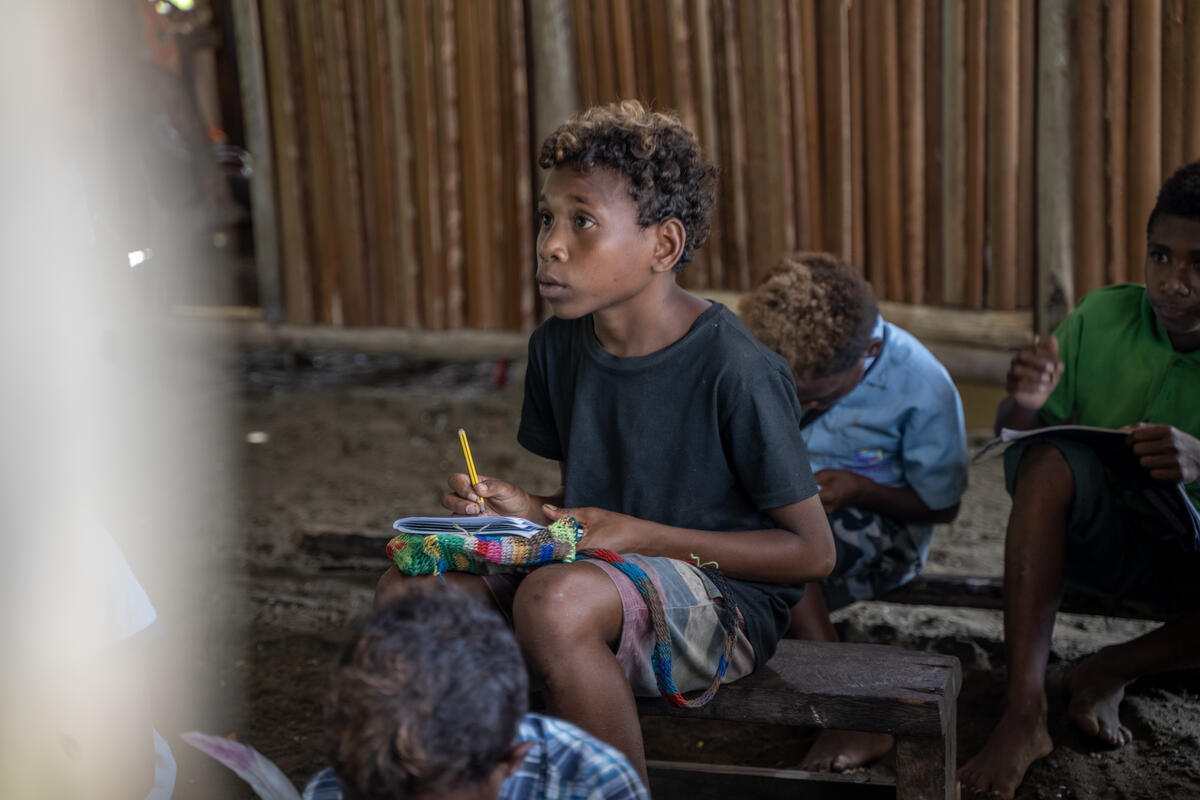
About this project
This two-year project will electrify five remote schools in Tinputz, North Bougainville. Each school will receive a solar mini-grid with battery storage, connecting classrooms, administration buildings and teachers’ houses across the campuses, along with motion-sensor solar streetlights for pathways, staff housing and ablution areas.
Reliable electricity will transform how these schools operate for their 1,580 students and 54 teachers. Lighting, communications, printing and device charging will support lesson preparation and school administration. Electrified housing will improve living conditions for teachers in remote postings. Safety lighting will make school compounds safer after dark, particularly for girls, women teachers and children with disabilities.
Schools will also manage a lending library of quality-assured portable solar lanterns, issued to students for the school year and available to other households in the community. Up to 2,000 households – around 9,780 people – will gain safe study lighting, phone charging and radio access, replacing costly and hazardous kerosene and battery lighting.
The project is designed for long-term local ownership. Each school will establish an Energy Management Committee with strong representation of women, train at least two local system custodians and build operations and maintenance costs into its annual planning, supported by a roving technician model, remote system monitoring and long-term supplier warranties. The project will also generate practical evidence on system design, governance and delivery to inform future school electrification across Bougainville and the Pacific.
Context
The project aligns with Papua New Guinea’s national energy and education plans and Bougainville’s Strategic Energy Plan 2023-2033. Bougainville has some of the lowest access to electricity in the Pacific. More than 90% of its population lacks access to modern electricity, with grid infrastructure largely confined to the urban centres of Buka and Arawa. Nationally, only around 20% of Papua New Guinea’s population has access to electricity, falling below 5% in rural areas.
For remote schools, this means little or no power for even the most essential services. Where electricity exists, it typically comes from small petrol generators that are costly to run, difficult to maintain and vulnerable to fuel shortages and transport disruption. Without reliable power, teachers cannot prepare lessons after dark, school administration and communications are constrained and unlit pathways, staff housing and toilets create safety risks. These burdens fall hardest on girls, children with disabilities and teachers living on site.
North Bougainville has the lowest education access rate of Bougainville’s districts and the five selected schools are all more than 10 kilometres from the grid. Off-grid solar with battery storage, designed for Bougainville’s tropical coastal conditions and backed by local maintenance capability, offers a reliable, affordable and climate-resilient alternative.
Thank you for making it a priority and commitment for the intervention on the provision of solar power to our schools in Tinputz District. That sustainable solution to ensuring our student and teachers have a consistent source of clean, green, and sustainable power supply for proper lighting for night studies, safety, security and communication will certainly make a difference in our teachers and students teaching and learning.
– Ms Dorothy Kenneth
Secretary, Autonomous Bougainville Administration / Department of Education