As part of our Women in Power series, we are celebrating the remarkable leaders driving the Pacific and Timor-Leste’s clean energy transition.
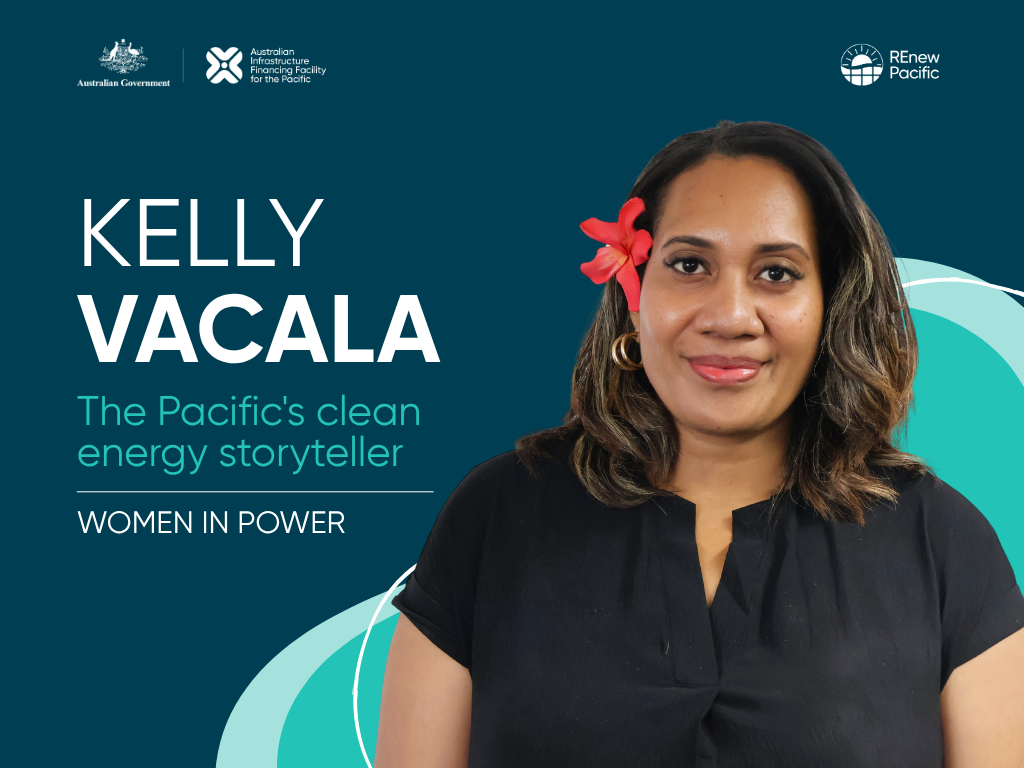
Across the Pacific, the shift to clean and reliable energy is as much a story about people as it is about infrastructure, and few people understand that better than Kelly Daniel Vacala. At 32, Kelly leads Regional Communications and Knowledge Sharing for the Global Green Growth Institute (GGGI) across the Pacific, based in Fiji. Her work spans climate, clean energy and sustainable development, helping to connect the work happening across the region with the people and communities at its centre.
Kelly began her career in journalism, where she developed a passion for storytelling and a deep appreciation for how communication can give people a voice and create change. That experience eventually led her into strategic communications and development, working on climate initiatives across the Pacific. “My journey into this field has been driven by a desire to use communication for something bigger than simply sharing information,” she says. “To help people understand complex issues, amplify voices that deserve to be heard and contribute to solutions that can improve lives.”
Over more than 12 years, Kelly has brought that perspective to the region’s clean energy transition, including through her work with GGGI supporting communications for REnew Pacific. Her role is about making the work visible, strengthening connections between partners and bringing Pacific voices into conversations about the region’s future.
One example of this can be seen in GGGI’s work to improve water security across Fiji’s remote maritime islands. In partnership with the Water Authority of Fiji (WAF), the Department of Water and Sewerage and the Australian Government, GGGI is delivering solar-powered water pumping systems to seven sites across Lakeba, Rotuma and Vanuabalavu. The systems will replace diesel-only pumps, which are costly to run and can be vulnerable to breakdowns, particularly during severe weather and cyclones. The new solar-hybrid systems are expected to improve water security for close to 4,900 people, while reducing reliance on imported fuel and the emissions that come with it.
The project also extends beyond the infrastructure itself, with training and governance support for Water Authority staff and local communities. Inclusion of women, people with disabilities and other vulnerable groups in these opportunities are a core focus of the training, to ensure the benefits reach all members of the community. For Kelly, projects like this are an opportunity to show what the energy transition looks like in practice and the people who are making it happen. “What I enjoy most is seeing people at the community and rural level gain access to clean and reliable energy solutions that can genuinely improve their everyday lives,” she says. “I love being able to tell those stories and show the real people behind the work.”
Those community-level changes are what keeps Kelly connected to the bigger picture. They also shape her understanding of what leadership looks like in a sector that is changing rapidly. “Being a woman in this sector means having the confidence to take up space, speak up and bring my perspective to the table,” Kelly reflects. “I’ve also learned that leadership is not about knowing everything; it’s about being willing to listen, learn and keep pushing forward.” She has seen firsthand the difference women can make, particularly when they have a seat at the table and an opportunity to influence decisions affecting their own communities.
Looking ahead, Kelly wants to continue growing into regional leadership, with ambitions to lead high-impact campaigns, mentor other women in communications and development and have a stronger voice in shaping programmes and partnerships that drive practical change across the Pacific. Her approach to leadership is summed up in the line she hopes people remember her by: “Use your voice with purpose, lead with conviction and leave every space stronger because you were in it.”
That message is particularly important for the next generation of women entering the sector. “Don’t be afraid to take up space, use your voice and believe that you belong in every room you aspire to be in,” she says. “You don’t have to wait until you feel ready or have all the answers. Learn, be courageous and keep moving forward. And when you make it, remember to reach back and create space for other women to rise with you.”
Kelly has some words of wisdom for businesses and stakeholders, too. “Keep communities at the centre of every clean energy investment,” she says. “Listen to their needs, involve them in decision-making and make sure solutions are practical, affordable, and sustainable beyond the life of a project.” She also urges greater investment in women and young people, giving them the opportunity to lead, innovate and shape the solutions that affect their communities.
In her view, the Pacific clean energy transition must be inclusive, locally driven and shaped by the people it serves. “There is enormous talent across our region,” she says, “and when we invest in people alongside infrastructure, we create solutions that are not only sustainable, but transformative.”
Kelly’s story is part of two broader projects delivered by GGGI Pacific across Fiji and Vanuatu, bringing clean, reliable energy and safe water to remote island communities and helping them build resilience to energy insecurity and climate change.
Across the region, women are stepping into roles that are reshaping how energy is generated, managed and shared. Their leadership is powering homes, schools and businesses with clean energy, building stronger, more resilient communities and showing what an inclusive energy future looks like.
We’re proud to showcase some of these remarkable leaders through our Women in Power series, which highlights women powering change through REnew Pacific.
They are supported by the Pacific Climate Infrastructure Financing Partnership (PCIFP), a $350 million Australian Government initiative delivered by the Australian Infrastructure Financing Facility for the Pacific (AIFFP).