As part of our Women in Power series, we are celebrating the remarkable leaders driving the Pacific and Timor-Leste’s clean energy transition.
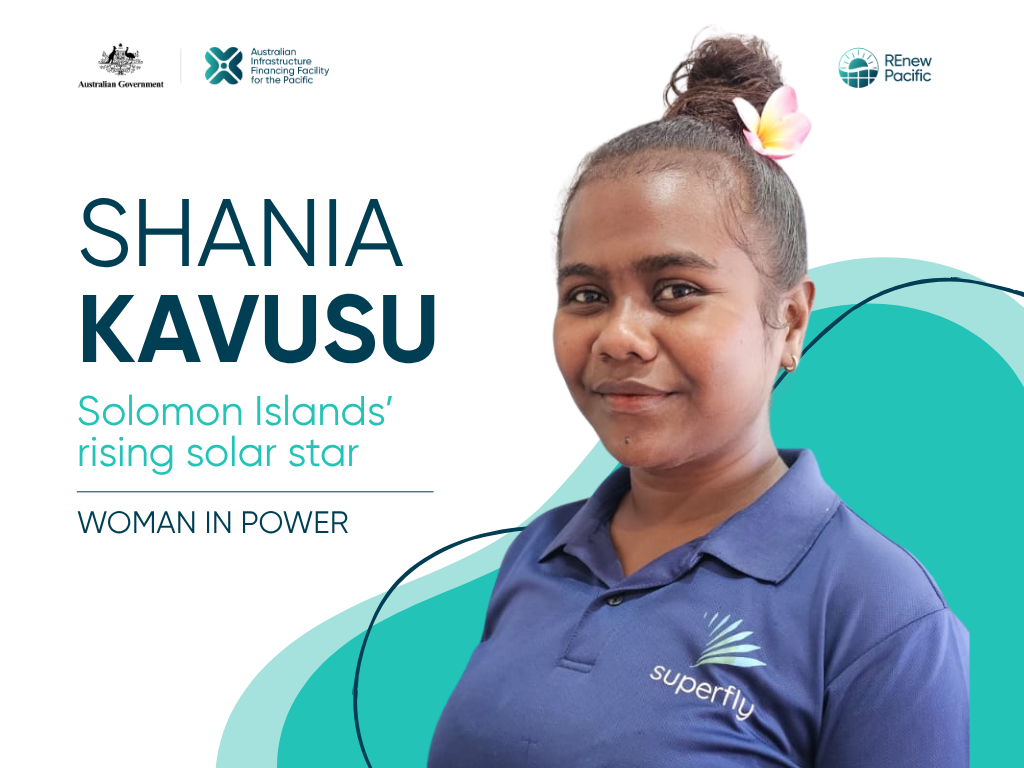
In Solomon Islands, many remote schools and health centres have long depended on diesel generators, with high fuel costs, limited hours and services that stop when the power does. Solar energy is changing that and Shania Kavusu is among the newest members of the team making it happen. At 26, she is part of Superfly Limited, a locally-owned Solomon Islands solar company, where she is training to become a solar technician and is the only woman on the team.
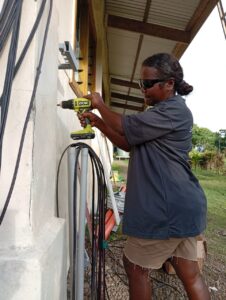
Shania came to Superfly through the Solomon Islands Infrastructure Program (SIIP), a DFAT-supported initiative, where she trained before stepping onto the Superfly team a year ago. Now she is being put through the company’s training process, learning the practical side of the work from the ground up. A recent day on site found her helping a colleague connect a solar power control panel: hands-on, technical work at the heart of the project.
Her role already stretches in several directions. “I am versatile in my role,” she says. “I assist in managing the storage facility and tool room to keep our equipment organised. I have also assisted our sales team and travelled on-site to help install solar systems at local schools.”
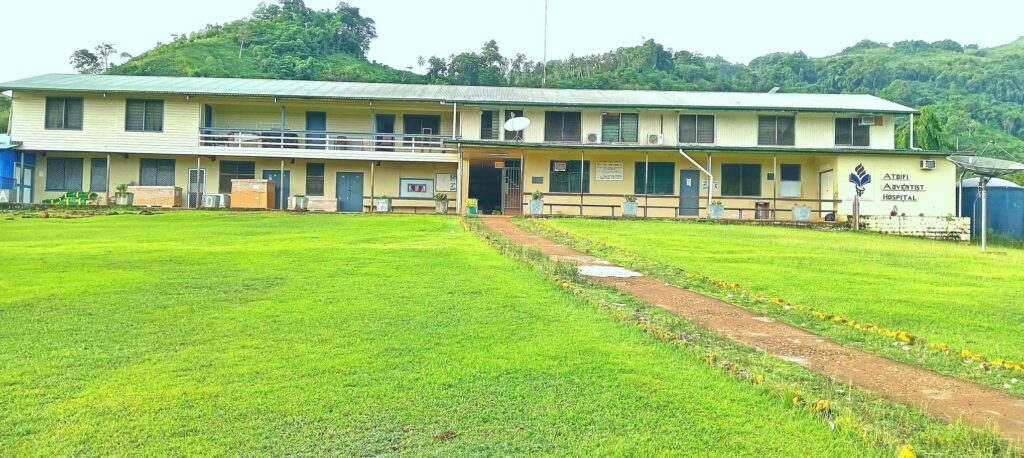
Superfly is leading REnew Pacific’s first project that is bringing clean, reliable solar power to healthcare and education across three provinces of the Solomon Islands. The project is installing solar hybrid systems at Atoifi Adventist Hospital in Eastern Malaita, which serves more than 81,000 people and trains over half of the country’s nurses, and has already installed systems at Goldie College in Western Province and Sir Dudley Tuti College in Isabel Province, two remote boarding schools home to over 1,200 students and staff. Replacing diesel generators with solar photovoltaic arrays, battery storage and hybrid inverters will cut fuel use by up to 95 per cent, keeping power on around the clock for emergency care and maternity services and giving students extended study hours and safer campuses. Shania is part of the team behind that work.
What she enjoys most is the variety. “It is rewarding to go out to schools to help set up clean solar power, assist customers in the sales department and keep our main tool room and storage running smoothly,” she says. That range has taught her something bigger about where women belong in this industry. “As the only lady at Superfly, I have learned that women can thrive across all areas of a technical business, from customer sales to site installations and inventory logistics,” she reflects. “It has taught me confidence and resilience.”
She is already looking ahead. “I want to keep expanding my skills across sales, logistics and hands-on solar technical work so I can continue to grow with Superfly and pave the way for other women,” she says.
Her message to young girls and women is to not be afraid to step into fields where you might be the only woman. “You are capable of doing many different jobs, learning quickly and making a real impact,” she says.
She has a message for employers too. “I encourage businesses to keep partnering with programs like SIIP to hire women and people with disabilities,” she says. “When you give us a chance, we bring dedication, versatility and hard work to the team.” She is quick to thank those who have backed her. “A big thank you to SIIP and the Superfly team for supporting me through a wonderful first year. I look forward to many more.”
For Shania, being the only woman on the team is not a barrier but a point of pride and proof of what is possible. “I am proud to be the only lady breaking barriers at Superfly,” she says, “proving that we can handle everything from sales and storage to powering up our schools.”
Shania’s story is part of the broader project that is providing clean, renewable energy to power healthcare, education and essential services across Solomon Islands.
Across the region, women are stepping into roles that are reshaping how energy is generated, managed and shared. Their leadership is powering homes, schools and businesses with clean energy, building stronger, more resilient communities and showing what an inclusive energy future looks like.
We’re proud to showcase some of these remarkable leaders through our Women in Power series, which highlights women powering change through REnew Pacific.
They are supported by the Pacific Climate Infrastructure Financing Partnership (PCIFP), a $350 million Australian Government initiative delivered by the Australian Infrastructure Financing Facility for the Pacific (AIFFP).